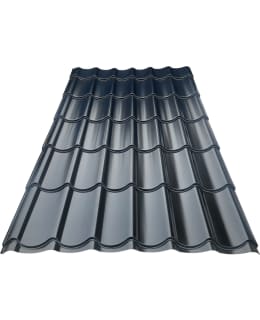
An excellent product for covering small buildings. The size of the panels is such that they are easy to transport to the site, even with a small trailer, and can even be installed alone if required. Warma Brick Tile can be extended by overlapping vertically and laterally.
- Material: steel tubular sheet with 0.45mm polyester coating
- Colour: black RR33
- Plate lengths: 2000mm (5 brick patterns) and 800mm (2 brick patterns)
- Tile pattern dimensions: 350mm
- Bellet useful width: 110cm
- Profile height: 38mm
Installation instructions:
Profiles handling and preparation for installation.
Cold steel panels can easily bend and should be handled with care. In addition, the sheets may also stretch. Any scratches or other surface damage may be removed with suitable spray paints. Any inclined cuts, gaps in penetrations, etc., will be made on site during installation. The tiles shall be worked with a hand-held chisel, gouge, pattern saw or hacksaw . Under no circumstances should an angle grinder be used, as the sparks generated during cutting will burn through the protective layer of the sheet! Steel debris resulting from the handling of the sheets must be carefully removed with a brush. Steel residues left on the surface will start to rust and may damage the surface of the sheet. Dirty plates should be cleaned with household cleaning agents; the use of solvents or other harsh chemicals is prohibited. We recommend painting the cut edges of the panels, the edges of the eaves and the enabling joints with a paint suitable for repair/replace
painting of the panels after installation.
Drain Cover
Underlayment must be used under the panel to prevent condensation water from entering the structure. Install the underlayment parallel to the ridge, starting at the bottom gutter. Fasten the underlay to the roof trusses, e.g. with a staple. The minimum spacing between the underlay strips is 150 mm. Do not clamp the underlay tightly between the rafters, but leave it 'hanging' for about 20-30 mm. The underlay is cut at the ridge.
Boards and end boards
The boards used are 25x100 boards if the distance between the top batten is 900 mm or 32x100 boards if the distance between the batten is greater. Nail the screws to the roof truss with 2.8 x 75 mm hot-dip galvanised nails, hammering diagonally (2 nails per intersection). The first screw must be 10 to 12 mm thicker than the depth of the groove in the cross-section. The top edge of the roof end board should be 40 mm higher than the grid boards,
so that the edge cable is well supported by it.
Fixing the panels
Roofing screws with gasket are used to fix the roof panels. The screws are tightened with an electric drill with a seat. The roof plate is fixed to the grid from the bottom of the corrugation. The normal length of the screws for this method of fixing is 25-28 mm. The sheets are fixed together at the horizontal joint at the base of each corrugation and vertically at the top of the corrugation. At the bottom and top of the eaves, the plate is fixed to the grid at the bottom of every other wave.