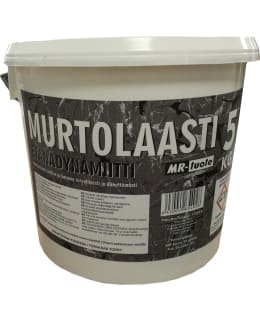
Ethanadynamite / Fractional load 5 kg. Ideal for: rock quarrying, rock chipping, rock cutting, yard clearing, demolition of concrete and reinforced concrete structures such as piers, stairs, plinths, elements, etc.
Important information before use
The holes to be drilled must be clean and free of water. The mortar should be mixed so that it does not harden or clump. The mortar must not be too thick to be easily poured into the holes. After mixing, the ready mix is poured into the drilled holes as a liquid. The mortar can be mixed, for example, with the help of a drill bit. Depending on the weather and conditions, you have to wait 1-2 days after pouring the grout into the holes, after which the blocks to be broken up are usually broken up. Depending on the size of the hole, the flow rate is about 80cm holes per kg of powder.
Use of the product
Drill holes in the material to be split with the stone drill at 15-60cm intervals using a 30-40mm drill bit. For best results, test how the material behaves by drilling a few holes, as concrete, stone, rock etc. have different cracking properties. The depth of the holes is also affected by the material, but a depth of less than 75% of the height of the object is not recommended. Sometimes even deeper holes are required.
Mixing ratio: 3:1 (3 parts powder to 1 part water). Mixing the whole bag at once:
1,5l water + 5kg powder. Pour the powder into the mixing bowl first, then add the water. Stir with a drill or similar until the mixture is mixed and runny (so that it can be easily poured into the holes). No lumps should remain in the mass. Do not use a glass or metal container when mixing. The holes drilled must be clean. Pour the liquid mass into the holes as soon as possible after mixing (max. 5min). The mortar must be liquid when used, otherwise the mortar should not be used. Once you have filled all the holes, wait for the block to be broken to crack. NOTE! This can take several days depending on the block to be broken and the outside temperature. If the block does not crack, increase the number of holes and check that there are no lumps, etc. in the mass. The recommended operating temperature is +10 to +20 degrees Celsius. If there is excess product after use, pour the mixture over a plastic bag, for example, and leave it long enough for the reaction to take place, then dispose of the material properly. NOTE! During the reaction the substance may bubble and boil violently.
Holes for different types of boulders
Stone boulder
Holes are about 10cm apart depending on the type of stone
. The depth of the holes should be at least 80-90% of the total height of the boulder.
The holes should be drilled evenly spaced, in the same direction. Hole diameter should be 28-40mm.
Concrete boulders
Hole spacing approx. 40cm apart. Hole depth at least 75% of the total height of the block.
The holes should be drilled evenly spaced, in the same direction. Use a drill bit of approx. 30mm.
Rock extraction
Always drill the holes in line with the outer edge of the rock cut. First drill a test hole according to the outermost edge, e.g. 30cm from the edge. If the edge is chipped, drill the other holes at the same distance. Drill the holes to at least the depth of the rock cut. Use a drill bit of about 40mm.